Make Storyline number variables become your turbocharged game engine
Updated: Oct 12, 2020
I'm super lucky to work at Wolf Learning and work occasionally on a preferred e-learning project. Usually, it's something I've never created before and this time it happened to be a board game that I always wanted to build in Storyline.
As the world's situation is dominated by COVID-19 I called my game...VIRUS WARS.
In this game, you play the role of a nurse fighting with a virus attack. The virus is very strong at the start (100% vitality) and you got no power to beat it but every time you roll the dice and stop on a colored spot you’ll be given a chance to answer a question. If you’re correct, you’ll get some points, your strength increases and the virus will weaken. If you’re unlucky to answer enough questions and you get to the end of the board, you’ll be given a final question to beat this pesky virus.
I used multiple number variables to make everything work in Storyline and they’re the engine of the game.
Here's a list of number variables I made work to:
- measure nurse and virus strength starting with 100% vitality for the virus and 0% for nurse
- roll the dice (random number variable generating 1-6 dots on each face six-sided dice)
- move the player along the path by the number of moves the dice rolled
- count on which numbered spot the player is (there are 50 spots in total)
- count questions asked

It wouldn't be possible to build this game without number variables which were my best friends in Storyline for this project.
When you look at the play path being numbered from 1 to 50, you can see the pawn can go either up, right, or down and it happens thanks to motion paths.
Every time you roll the dice - the dispatcher layer is shown which determines the direction of movement and activating either the up, right or down layer with a few variables making some maths on layer start.
This tutorial by elearning Locker was very helpful if you’d like to know all the details on how to set your layers up and I’m grateful to David Charney to share his practical tips on the game mechanics.
Let’s spread this knowledge even further!
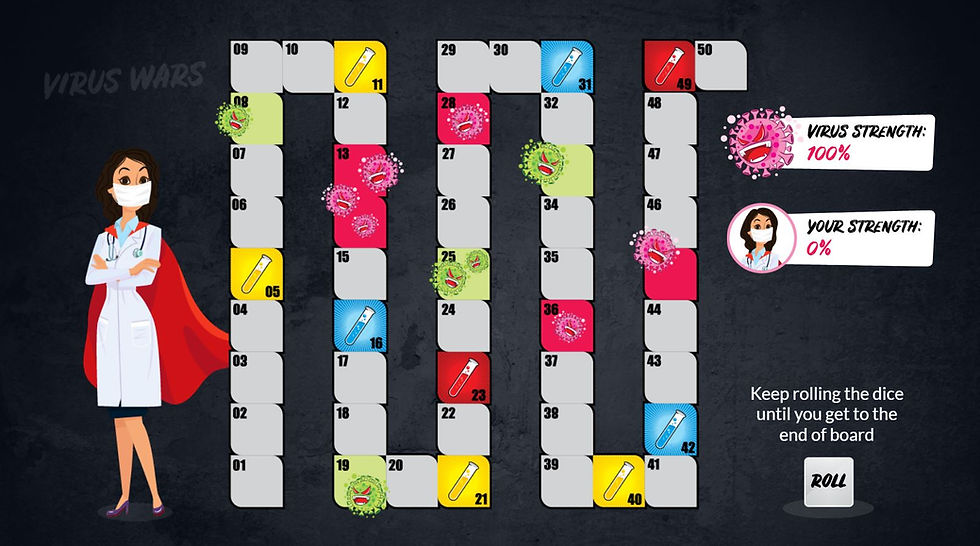
(click image to launch the interaction)
In my questions, there's lorem ipsum for the moment as I wanted to have the functionality working in the first place but it can be easily replaced with relevant content.
Check this game yourself now and let me know your thoughts.


I enjoyed reading this post because it showed a practical use of Storyline number variables rather than just explaining the theory. The Virus Wars example was interesting, especially how the game used variables to track the nurse’s strength, the virus vitality, dice rolls, player movement across 50 spaces, and question counts. It really highlighted how variables can become the engine behind interactive learning experiences. While working on Assignment Writing tasks through projects connected with New Assignment Help, I often notice similar logic-based structures being discussed. It made me curious about what other creative game mechanics could be built using number variables in Storyline.
The ideas about using number variables in eLearning projects were really creative and practical for course designers. While working on online learning assignments, I used online statistics course help service to manage deadlines and focus more on interactive projects like these. I liked how the article explained technical ideas in a simple and engaging way.
Using number variables as a game engine in Storyline is such a brilliant way to push the boundaries of what’s possible in e-learning—the logic behind the triggers you’ve outlined here is honestly a total game-changer for gamification. I’ve been trying to implement similar variable-based scoring in my own projects, but I’ll admit the quantitative logic can be a bit intimidating when you're still a student! In fact, the mathematical modeling for my latest course design became so complex that I actually reached out to an economics assignment help service just to help me bridge the gap with the data analysis part of my degree. It’s given me the extra time I needed to actually get into the 'hood' of Storyline and…
This post kept my attention because the writing sounded casual and straightforward the whole time.
I’ve been looking for better ways to improve fast clicking naturally. The Jitter Clicking Test page explains click counter tools and jitter clicking in a really simple format.
This post is a complete game-changer for anyone looking to push the boundaries of Articulate Storyline beyond basic slides and into the realm of immersive, logic-driven learning. Using number variables to create a "game engine" feel is such a clever way to increase engagement, especially when dealing with complex subject matter that requires a high level of interactivity. It reminds me of the challenges students face when trying to simplify dense technical data into something digestible; for instance, those working on complex laboratory reports often look for science assignment writing help to ensure their data logic is as sound as the variables in a well-built game. Thanks for sharing these "turbocharged" tips—it’s amazing to see how a bit of backend logic…